RAK Engineering
Engineering solutions for the whole operation
From the first drawing to the final invoice, our software keeps every record connected. Drilling analytics for oil and gas, and edge systems that read your machines directly.
What we build
Every product, and how they connect
Select a product to see what it does.
Industrial tools and equipment: coming soon.
Industries
How it is used, industry by industry
Each example follows one job from start to finish and shows which product does what. A company can start with one product and add the others later.
Oil and gasDrill bit and downhole tool manufacturers
An 8½-inch six-blade PDC bit, from a customer's email to the evidence that shapes its successor.
Who owns what, along one lifecycle
The same item, three times
As designed, as built, as used
One model, with three sets of data on it from three parts of the business. Here the model is a bit face and the positions are cutter pockets; in another shop they are weld seams or bearing positions. The geometry is named once, and every later measurement attaches to that name.
As designed
B1-C1 … B3-G1 — named on the released model
Every position named and placed by the designer, on the released model.
As built
pass · near limit · fail — violet: instrument out of calibration
Measurements against tolerance, with the evidence and the instrument's calibration behind each one.
As used
dull grade 0 – 8
Graded on a phone at the rig, position by position, then averaged across every run of that design.
One bit, followed through
What happens, in order
The enquiry arrives as an email
A drilling engineer writes asking for a bit for a well, with the well profile attached. The mail lands in engineering's shared mailbox and becomes a numbered request, with the attachment already filed and the sender recognised.
It is quoted, and the order is recorded
The bit is quoted to the operator from your price list. When the order comes, it is recorded against the customer, the materials are bought against purchase orders, and a manufacturing order draws them from stock at cost.
It is worked, reviewed and approved
Applications, then product development, then the design lead. Anyone can see which stage it is at and who is waiting on whom. The design lead approves at the gate, and the approved drawing is filed into the register as a controlled document, numbered and stamped.
The design carries its own map
The released model holds the bill of material and the cutter layout, every pocket named and positioned. Every later measurement and every field grade attaches to that map.
It is marked up before anyone cuts metal
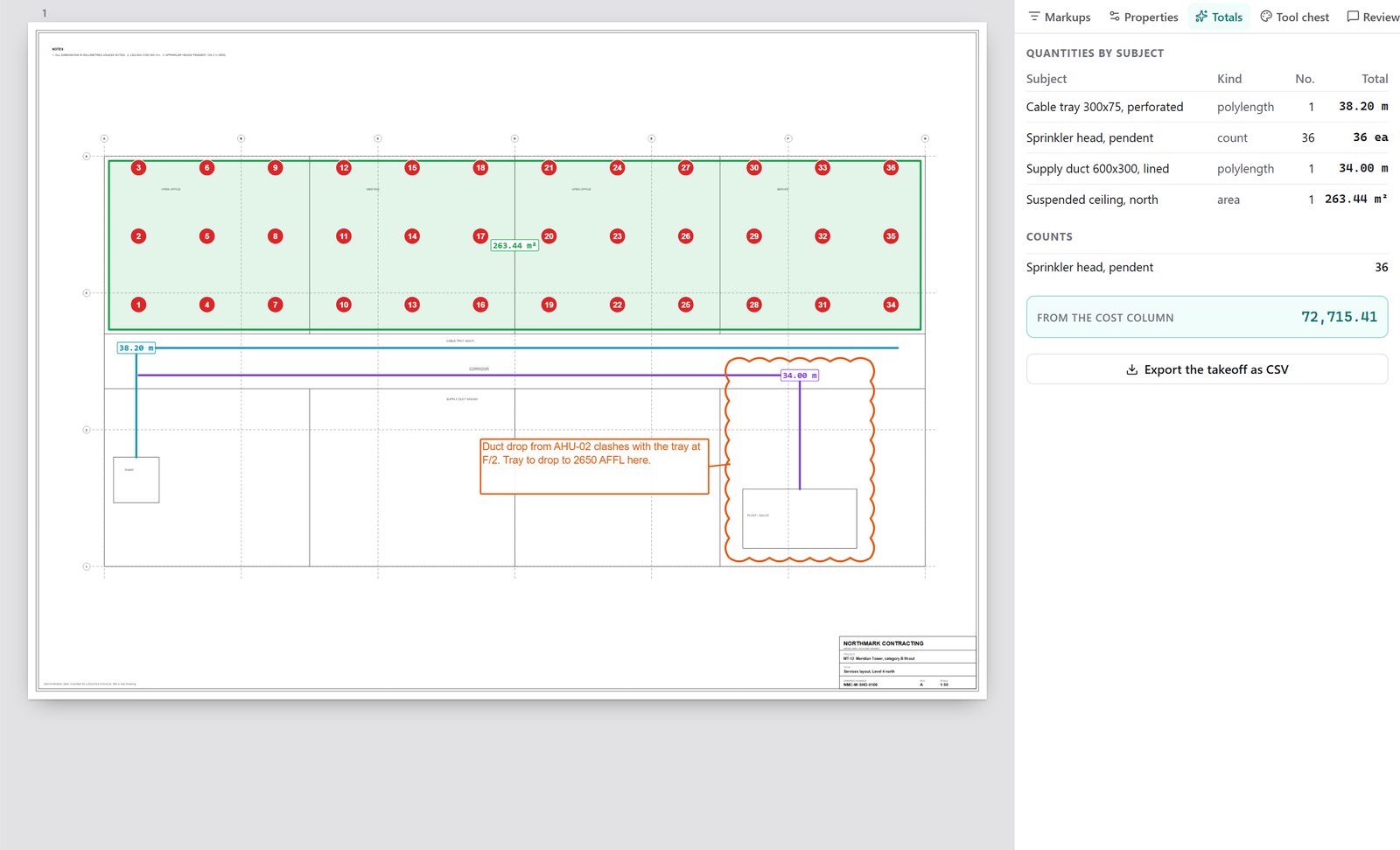
The reviewer opens the drawing, measures on it to scale and marks it up with somebody else on the same sheet. The markup stays attached to the revision it was made against.
Nobody signs a bad braze
The rules are checked before the signature is offered: required evidence present, sensors inside their band, no over-temperature excursion. The signature, the checks and the readings stay together for the life of the tool.
The serial number enters the fleet
The finished bit is a tool now: a location, a state, certificates with expiry dates, and a history. It is reserved against a job, picked, and shipped on a delivery note that carries its certificates.
It drills, and the morning reports are read for you
Depth, hours, rate of penetration, weight on bit, revolutions, formation in and out, lifted from the daily reports and joined to the run, the rig and the well. Price lists and billing rules turn what was used into what it was worth.
It comes back, and is graded where it lies
The field engineer grades it on a phone at the rig, cutter by cutter, against the pocket names the designer used, with photographs. Back at the workshop the tool is received, inspected and repaired or retired, and every hour and part is on the work order.
The pattern shows up across runs
Filter every run of that design by formation, weight on bit or hours. The picture is drawn on the same model the designer released, so the next design starts from evidence.
The customer never had to phone
They signed in and saw their own tools on hire, their own due-back dates, their own certificates and reports.
A cutter pocket called B1-C3 is named once, when the bit is designed. The inspector measures B1-C3. The field engineer grades B1-C3. Nobody re-invents the name at any step.
ContractorsBuilding services, solar and automation
Electrical and mechanicalBuilding services contractors
A building services contract, from the tender drawings to the completion file: shop drawings, submittals, materials, tools, site inspections and milestone invoices.
One contract, followed through
What happens, in order
The contract becomes a project
Tasks, timesheets and milestone billing for the job. Materials are bought against purchase orders, matched to the supplier's bill and held in stock.
Shop drawings go to the consultant
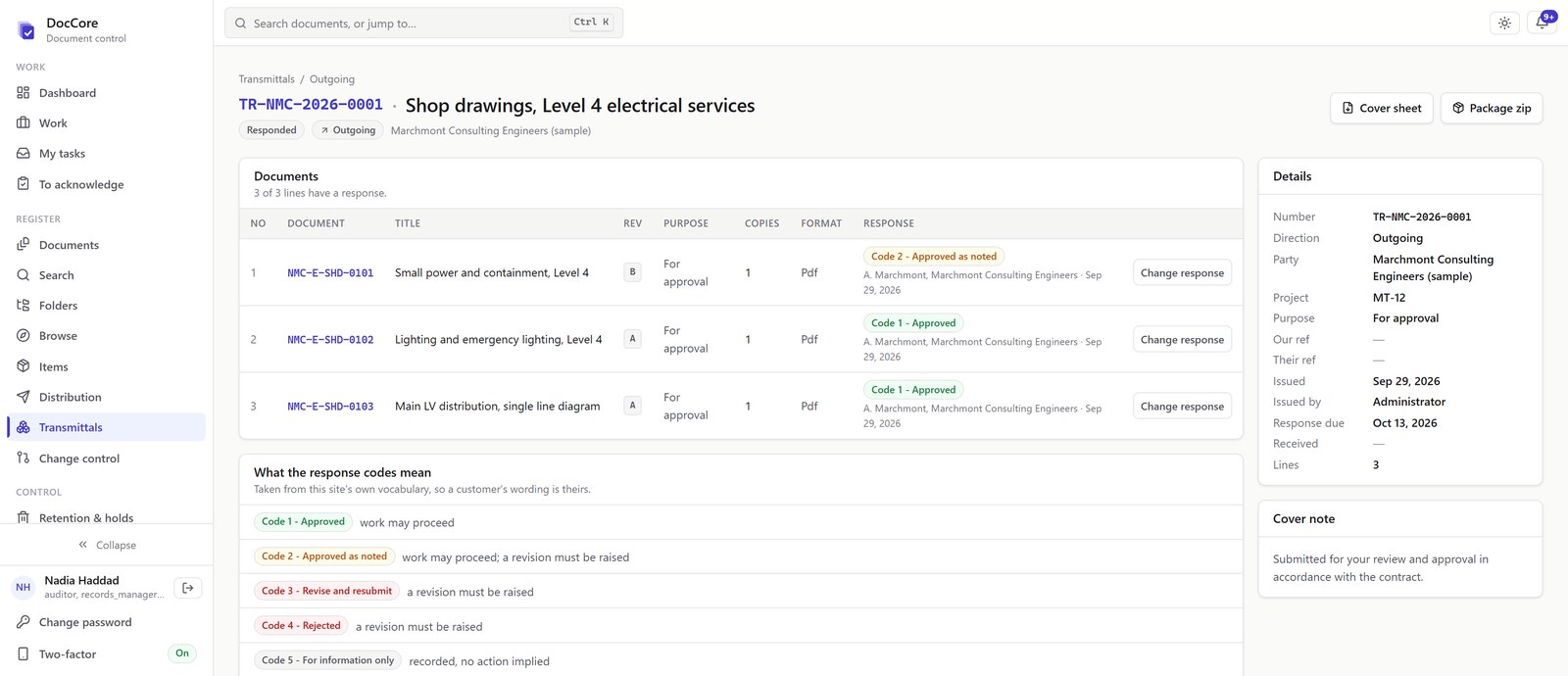
Shop drawings and material submittals go out on a transmittal. The consultant's response code is recorded against each drawing.
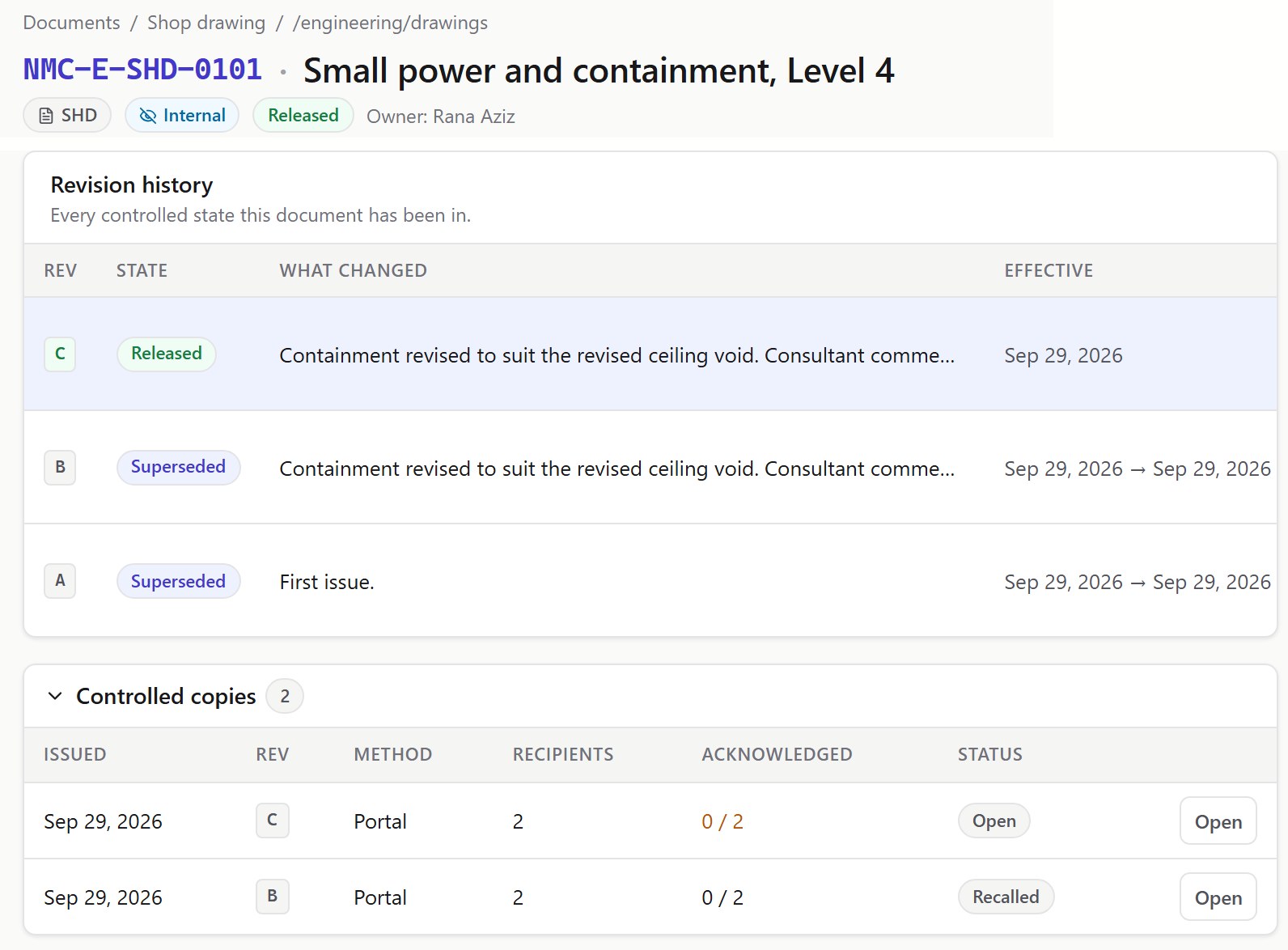
A returned drawing comes back as the next revision
The old copies are recalled. Each person on site receives a numbered copy of the current revision and confirms they have it.
Installed work is inspected
Each distribution board, pump set or air handling unit is inspected against the approved drawing, with readings and photographs, and signed only when the checks pass.
The client sees their own documents
The client signs in and sees the issued copy of the documents and reports for their project.
Each milestone is invoiced
With VAT, against the project. The books show the profit on the job.
The completion file is already there
Which revision was built, who approved what and when, on a tamper-evident audit trail.
On screen
Solar energySolar plant contractors
A ground-mounted solar plant, from the quotation to the plant in service: string layouts, datasheets, stock, commissioning tests and remote readings from the inverters.
One plant, followed through
What happens, in order
The plant is quoted and won
The quotation, then the order, then a project with milestone billing for the installation.
The equipment is recorded
Modules, inverters, combiners and trackers each have a part number, with their datasheets and documents filed against them.
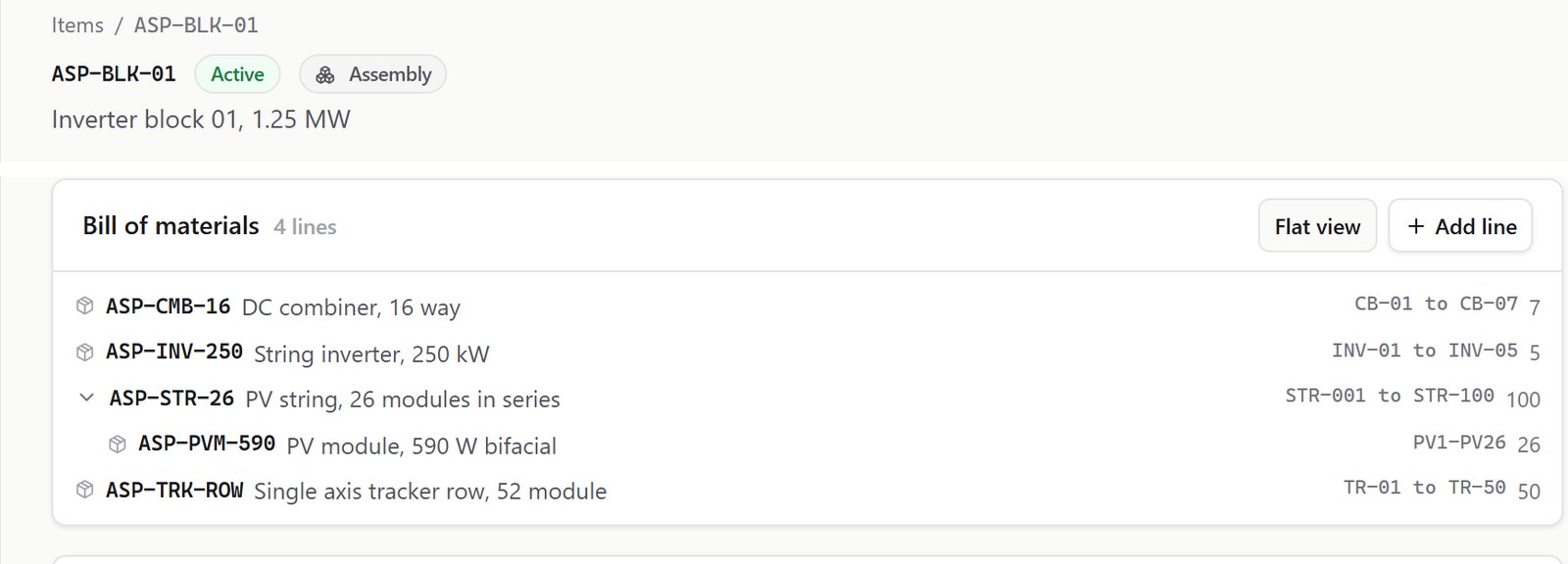
The plant is built up in blocks
Each inverter block shows what it is made of, down to the modules in every string, with the designators used on site.
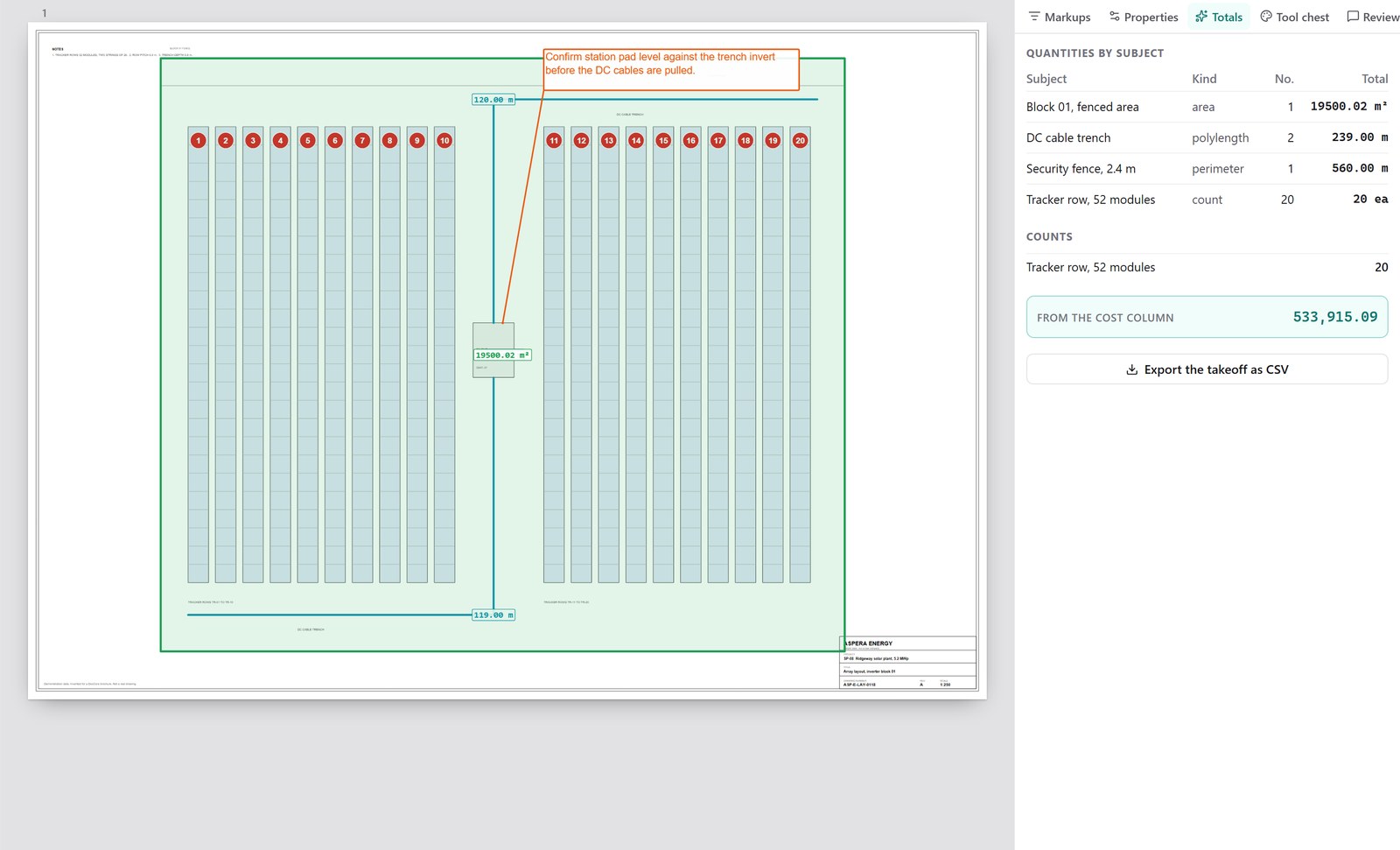
The layout is measured
Trench, fence, fenced area and tracker rows taken off the array layout and priced.
Panels and inverters are stocked
Across warehouse locations, costed at weighted average, and transferred to site as they are needed.
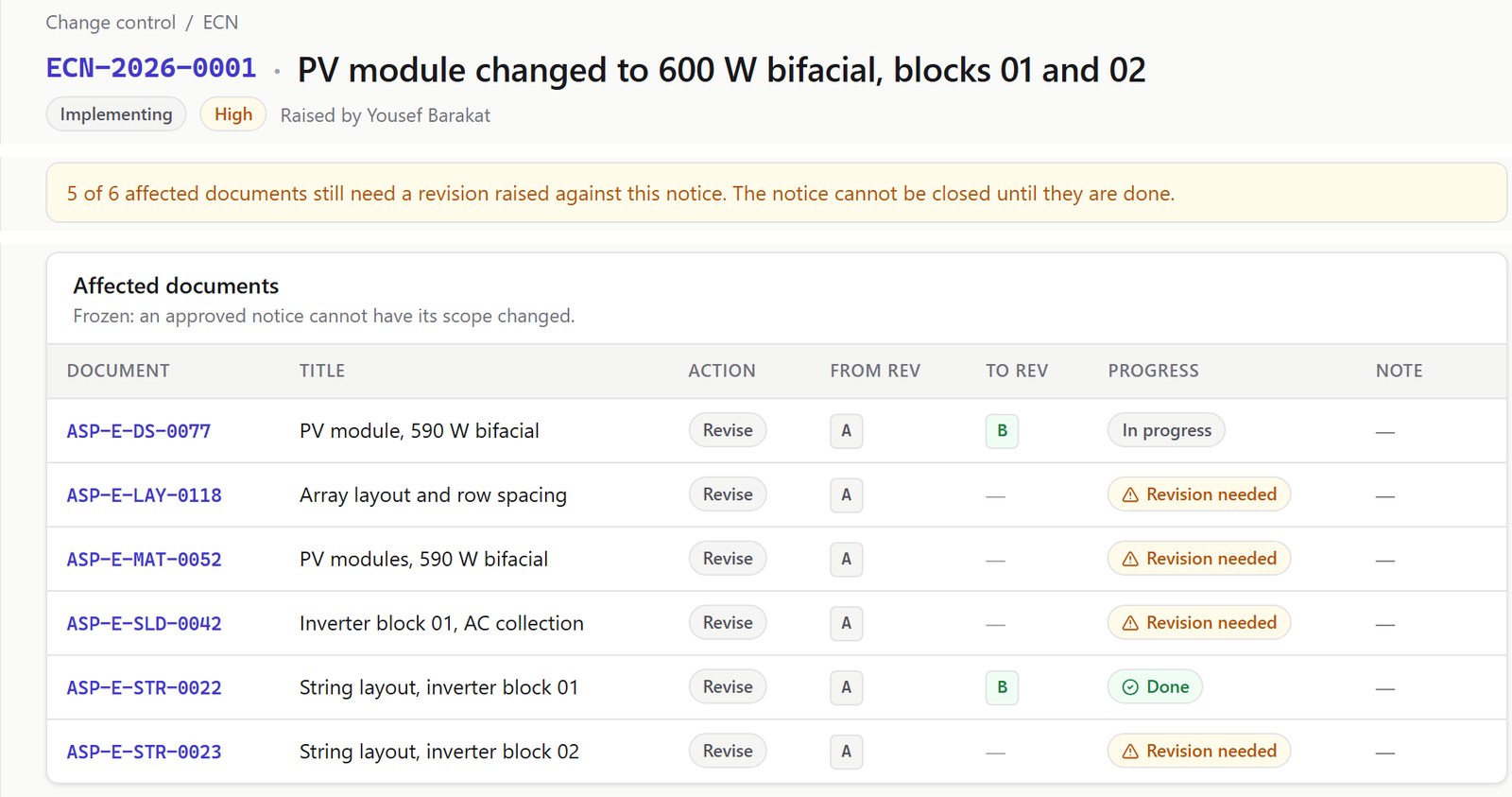
A change reaches every document
When a part changes, a change notice lists every document it affects and stays open until each is reissued.
Each string is tested
Commissioning readings are recorded against the string's designator, with the instrument used, and signed when the checks pass.
The client sees the plant's documents
The issued copy of the documents for their own plant.
On screen
Industrial automationControl system integrators
A control panel and its programme, from the quotation to commissioning: loop drawings, the cause and effect matrix, the factory and site tests, and the instruments left behind.
One system, followed through
What happens, in order
The job is quoted and run as a project
Engineering hours are logged against the project and billed by time or milestone. Equipment is bought and matched three ways.
The drawings are controlled
Loop drawings, I/O lists and panel drawings, each a controlled document at a known revision.
The panel is built and tested in the factory
Each panel, by serial number, is checked against the approved drawing and signed only when the checks pass.
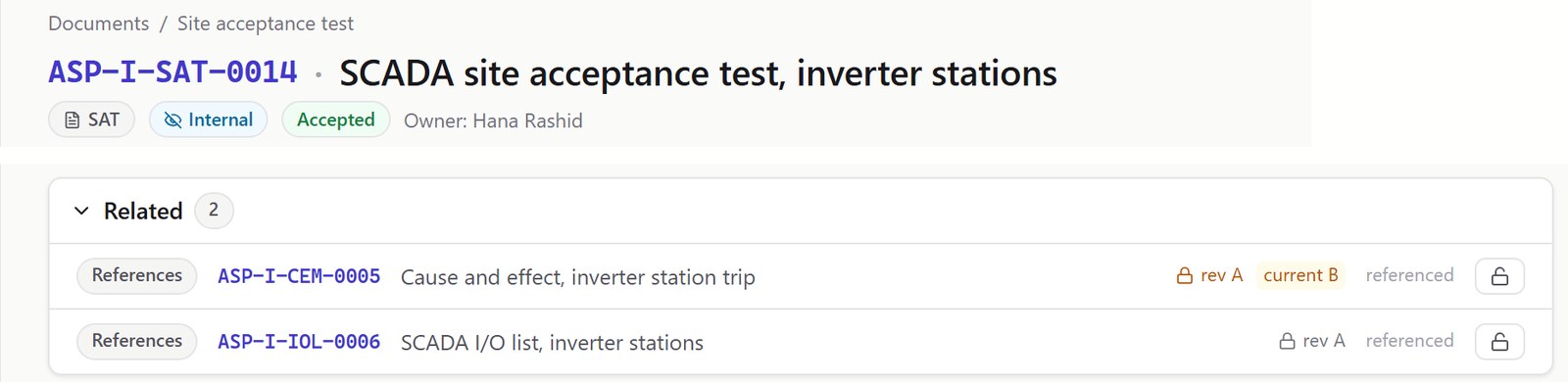
The site test points at its revision
The test record shows the revision of the matrix it tested, even after the matrix changes.
The instruments are handed over as equipment
Each instrument has a record, with its calibration due date, its spares and its maintenance.
The customer sees their documents
The issued copy of the drawings and test records for their own system.
The matrix that was approved is the matrix that was tested
Power equipmentPower transformer manufacturers
A 40 MVA, 132/13.8 kV oil-immersed power transformer, from the utility's enquiry to the test certificate and the unit in service.
One transformer, followed through
What happens, in order
The enquiry is quoted
The utility's enquiry becomes a quotation and, once won, an order. A large order can run as a project with milestone billing.
The design is released
The general arrangement drawing, the rating plate, the test procedure and the customer's specification, each numbered, revised and released.
The materials are bought
Core steel, copper, insulation and oil, bought against purchase orders and matched to the supplier's bill. The unit's manufacturing order draws them from stock at cost.
The unit is built, step by step
Core stacking, winding, drying, tanking and oil filling, each a step on the unit's traveller, scanned in and out against its serial number.
The routine tests are recorded, reading by reading
Winding resistance on every tap, ratio, insulation, losses, applied and induced voltage with partial discharge, lightning impulse: well over a hundred named measurements for one unit, each against its tolerance under IEC 60076.
Nobody signs a failed test
The signature is offered only when every reading passes and the required evidence is attached: impulse records, oil and gas analysis reports.
The utility sees its certificate
The customer signs in and sees the issued test certificate and documents for their own units.
Medical devicesClear aligner manufacturers
A set of clear aligners made to order: a series of trays for one case, each a different shape, from the clinic's order to the packed set.
One case, followed through
What happens, in order
The clinic's order is recorded
Dental clinics are customers, with their orders, invoices, payments and instalments. Each case can be tracked as a project.
The procedures are controlled
Work instructions, material specifications, machine settings and labelling, each numbered, revised and released. Staff confirm they have read each new revision.
A change reaches every document
A change to a material or a process lists every document it affects and stays open until each is reissued.
Each tray is inspected
Trimmed, polished and checked, with the result and photographs recorded against the case and the stage number. The set is signed only when every check passes.
The machines are maintained
Printers, thermoformers and trimmers each have a record, with maintenance planned on hours or cycles and calibration due dates.
The materials are in stock
Resin and sheet stock, bought by the box and held by the piece. Each case's manufacturing order draws on it at cost.
The clinic sees its documents, and is invoiced
The clinic signs in and sees the issued documents for its own cases. The case is invoiced with VAT.
The suite holds business and production records. It is not a clinical system and holds no patient records.
Trading and distributionMulti-brand distributors with shops
A distributor holding agencies for several brands, with a central warehouse and shops across the country.
One company, followed through
What happens, in order
Each brand runs as its own company
Several companies and several currencies in one installation, each with its own books.
The goods are bought from the brand
The purchase order, the receipt and the supplier's bill, matched three ways. Goods bought by the carton are stocked by the piece.
Agency documents are controlled
Agency agreements, product registrations, certificates, price lists and brand guidelines, each at its current revision, issued to the shops that need them.
Stock moves to the shops
Each shop is a stock location, with its stock on hand, transfers from the warehouse and stock counts.
Each shop has its own counter
Point of sale in every shop, with VAT, drawing on that shop's own stock. Larger customers are invoiced from a sales order.
The books close per company
Trial balance, profit and loss, balance sheet and a VAT summary by rate for any period, for each company.
The worked examples, the diagrams and the screens on this site use dummy sample data.
How it runs
On your hardware, or in the cloud
- Installed where you choose. A server or a capable PC in the office, or cloud infrastructure.
- Cloud options. Secure cloud infrastructure, or a virtual machine you provide. One installation per customer either way.
- Your data stays with you. Documents live in the product's own vault on your storage, checked for corruption and backed up as one unit.
- Licences are checked online occasionally.
- Everything is recorded. Who did what, when, and to which record.
Next
Read the manuals, or ask for a demonstration
The manuals cover installation, day-to-day use and administration. Access is granted per product, on request.
RAK Engineering · rakengine.com/ · support@rakengine.com